Tuesday, 10 September 2013

Monday, 9 September 2013


https://www.google.co.uk/search?q=australian+lifestyle&bav=on.2,or.r_cp.r_qf.&biw=1366&bih=667&bvm=pv.xjs.s.en_US.jkEW54nYU50.O&um=1&ie=UTF-8&hl=en&tbm=isch&source=og&sa=N&tab=wi&ei=ljMuUpanFcfb7Aatn4DYDA#facrc=_&imgdii=_&imgrc=P150DfIq7EBUOM%3A%3BsCDGGG729KHtbM%3Bhttp%253A%252F%252Fcdn.c.photoshelter.com%252Fimg-get%252FI0000nhIizs.Ff_4%252Fs%252F900%252F900%252FAustralian-Rodeo-Cowboys07.jpg%3Bhttp%253A%252F%252Fjameshoran.photoshelter.com%252Fimage%252FI0000nhIizs.Ff_4%3B900%3B600


Warm climate, informal people
Australia is so large that it experiences most climatic conditions, from tropical monsoons to hot, dry weather and snow. Generally, however, the climate is warm and temperate, particularly in the major coastal cities.
This relatively benign climate has resulted in a country where people spend a good deal of time outdoors at beaches, in the countryside or on sporting fields as either spectators or participants.
Australians tend to be gregarious and outgoing. Most are relatively informal socially and in their relationships with acquaintances and work colleagues.
In the workplace and among friends, Australians generally call each other by their first names. But this informality does not extend to physical contact. When meeting someone for the first time, it is usual to shake the person’s right hand with your right hand. People who do not know each other generally do not kiss or hug when meeting.
Australians queue or line up when waiting to be served in a shop, a bank, a government department, a cinema, or anywhere that a number of people are all seeking a service at the same time. Australians generally wait until it is their turn to be served or attended to. Being on time for meetings and appointments is important.
Links
http://www.dfat.gov.au/facts/people_culture.html
Links
http://www.dfat.gov.au/facts/people_culture.html
A national cuisine?
Australia has one of the most diverse cuisines in the world, thanks to Asian and European migrant influences, a dining public that is happy to try innovative dishes and access to a plentiful supply of fresh and high–quality produce.
Australia, one of the world’s most efficient agricultural nations, produces high–quality vegetables, fruit and grains, meat, poultry, seafood, and cheeses and other dairy products. In addition, many new industries have been established to accommodate the growing Australian taste for exotic foods, including Asian greens, nashi pears, lychees, olives and herbs. Aquaculture products such as farmed Atlantic salmon and southern bluefin tuna are now available as well as the great range of seafood that comes from the ocean surrounding Australia, including Moreton Bay bugs (shellfish), ‘banana’ prawns, barramundi fish and oysters.
Australians enjoy a huge range of food in restaurants and homes, reflecting the country’s cultural diversity. Southern Europe has combined with Asia and the Pacific for new flavours and tastes. Italian, Chinese, Indonesian, Japanese, Greek, Thai, Malay, French and Vietnamese restaurants are common, particularly in the capital cities. Middle Eastern flavours are also rapidly emerging, with Moroccan and Lebanese flavours being used with local ingredients in mainstream cooking with notable success.
Traditional Australian bush tucker is also becoming more common, particularly in northern Australian restaurants, where kangaroo, buffalo, crocodile and emu can often be found on menus.
Historically, there has never been a cuisine typically regarded as Australian. Instead, Australian fare has evolved with the distinct layers of flavours that each new culture has added. Homesick expatriate Australians sometimes hanker for Australian food such as lamingtons (a sponge cake square dipped in chocolate and coconut), pavlovas (a meringue dessert named after the Russian ballet dancer Anna Pavlova) and vegemite (a commercially produced spread made from yeast products).
The Australian wine sector is recognised internationally as producing a full range of high-quality wine styles and varietals to match any dish, from full-bodied reds and deep fruity whites to sparkling, dessert and fortified wines.
Links
http://www.dfat.gov.au/facts/people_culture.html
Links
http://www.dfat.gov.au/facts/people_culture.html
A sporting culture
Australians love their sport, both playing it and watching it.
Australia has often achieved impressive results at the elite level. In the 2004 Athens Olympic Games, Australia ranked fourth overall in the medal tally behind the United States, China and Russia. In the 2006 Football World Cup, Australia reached the final 16. Australia is also ranked the top cricketing nation in the world.
But it’s not just at this top level that Australians enjoy their sport. A recent national survey showed that more than 11 million Australians aged 15 or over participated at least once a week in physical activity for exercise, recreation and sport—a participation rate of almost 70 per cent. The 10 most popular physical activities were walking, aerobics/fitness, swimming, cycling, tennis, golf, running, bushwalking, football (often referred to as soccer in Australia) and netball. Other popular sporting activities include Australian football, rugby, hockey, basketball, baseball, car racing, horse racing, sailing and snow skiing.
The most watched sports in Australia include Australian Rules Football, a uniquely Australian game with roots traceable to early forms of rugby and Gaelic football, rugby league, rugby union and cricket. The Australian Open, held in Melbourne, is one of tennis’s four Grand Slam events. Australia has more than 120 national sporting organisations and thousands of state and local bodies.
Links
http://www.dfat.gov.au/facts/people_culture.html
Links
http://www.dfat.gov.au/facts/people_culture.html
Vibrant arts scene
Australia has a vibrant arts scene that reflects both the nation’s Indigenous cultural traditions and its rich mosaic of migrant cultures. All forms of the visual and performing arts have strong followings, including film, art, theatre, dance and music.
According to one survey, almost 13 million or 88 per cent of adult Australians attend at least one cultural event or performance every year. The most popular art form is film, attended by about 70 per cent of the population each year. More than 26 per cent attend a popular music concert; 25 per cent go to an art gallery or museum; 19 per cent see an opera or musical; 18 per cent attend live theatre; 11 per cent attend a dance performance; and 9 per cent attend a classical music concert.
Visual artists have played an important role in shaping and reflecting Australia’s image. They range from Aboriginal and Torres Strait Islander artists to the nationalist painters of the Heidelberg School in Victoria, symbolic surrealists such as Sidney Nolan, Arthur Boyd and Albert Tucker and modern artists reflecting issues confronting contemporary Australia. Other notable Australian artists include John Brack, William Dobell, Russell Drysdale, Margaret Olley, John Olsen, Margaret Preston, Clifton Pugh, Jeffrey Smart, Brett Whiteley and Fred Williams.
Australia has a strong literary tradition, which started with the storytelling of Indigenous Australians and continued with the oral stories of convicts arriving in Australia in the late 18th century. Australia has one Nobel Prize for Literature to its credit, with novelist Patrick White receiving the award in 1973. Other recent Australian novelists whose work has a particularly Australian flavour include Peter Carey, Bryce Courtenay, Kate Grenville, Elizabeth Jolley, Thomas Keneally, Christopher Koch, David Malouf, Colleen McCullough, Christina Stead, Morris West and Tim Winton.
Links
http://www.dfat.gov.au/facts/people_culture.html
Links
http://www.dfat.gov.au/facts/people_culture.html
A typical Australian?
Given the diverse nature of today’s Australia, some people question whether there is a ‘typical’ Australian. There is, of course, no shortage of popular stereotypes, some of which contradict each other.
For example, some people see Australians as egalitarian, irreverent people with a deep suspicion of authority while others regard them as mostly law-abiding and even conformist. Some people, particularly those living overseas, believe Australians live mainly in country areas, the Australian outback or the bush. In fact, more than 75 per cent of Australians live a cosmopolitan lifestyle in urban centres, mainly in the capital cities along the coast. Others see Australians as people who live in a ‘lucky country’ who love their leisure, particularly sport, both as spectators and as participants. In fact, Australians are among the hardest-working people in the world with some of the longest working hours in the developed world.
Another common perception of Australians is that they are informal, open and direct and say what they mean. They are also seen as people who believe in the principle of giving people a fair go and standing up for their mates, the disadvantaged and the underdog.
Many of these popular images have some truth to them and most Australians conform to at least some of them. But Australians, like people everywhere, cannot be so easily stereotyped. There are ‘typical’ Australians everywhere. But they are not all the same.
Links
http://www.dfat.gov.au/facts/people_culture.html
Links
http://www.dfat.gov.au/facts/people_culture.html
An egalitarian society
In most practical ways, Australia is an egalitarian society. This does not mean that everyone is the same or that everybody has equal wealth or property.
But it does mean that there are no formal or entrenched class distinctions in Australian society, as there are in some other countries. It also means that with hard work and commitment, people without high-level connections or influential patrons can realise their ambitions.
The unemployment rate is relatively low (in December 2007 it was 4.3 per cent) and the gross per capita income is around $39 000. All people are equal under the law in Australia and all Australians have the right to be respected and treated in a fair manner.
Links
http://www.dfat.gov.au/facts/people_culture.html
Links
http://www.dfat.gov.au/facts/people_culture.html
Australia's Shared Values
The defining feature of today’s Australia is not only the cultural diversity of its people, but the extent to which they are united by an overriding and unifying commitment to Australia.
Within the framework of Australia’s laws, all Australians have the right to express their culture and beliefs and to participate freely in Australia’s national life.
At the same time, everyone is expected to uphold the principles and shared values that support Australia’s way of life. These include:
- respect for equal worth, dignity and freedom of the individual
- freedom of speech and association
- freedom of religion and a secular government
- support for parliamentary democracy and the rule of law
- equality under the law
- equality of men and women
- equality of opportunity
- peacefulness
- a spirit of egalitarianism that embraces tolerance, mutual respect, and compassion for those in need. Australia also holds firmly to the belief that no one should be disadvantaged on the basis of their country of birth, cultural heritage, language, gender or religious belief.
Links
Thursday, 5 September 2013
Death and distress on the Orinoc
In Venezuela, a mysterious disease has killed nearly 40 people from indigenous river communities. In one village, 10% of the population has died. James Ingham investigates.
Venezuela's second biggest indigenous group live on the banks of the mighty River Orinoco.
It is impossible not to be impressed by the landscape here.
There is just so much water. The hundreds of tributaries and channels spill with wildlife.
A chorus of birds, frogs and monkeys fills the air. River dolphins break the surface, splashing through the brown water as it flows through long grassland and forests to the sea.
This is a beautiful and largely unspoilt area.
But it is this isolation that also makes life so hard for the Warao. These people have few material goods aside from the basic huts they live in. Theirs is a hand to mouth existence.
They get by, but, when illness strikes, they struggle and suffer.
The child mortality rate is high. Poor nutrition and hygiene and inadequate health care means simple preventable problems, like diarrhoea and respiratory infections, claim the lives of many infants.
Now, in some communities, something else is killing them.
Unexplained deaths
I met up with Charles Briggs, a professor of anthropology at the University of California at Berkeley and his wife Clara, a Venezuelan doctor.
Over the past few months, they have been helping the locals devise a new health plan.
Their work changed though, when it became apparent that something was bothering these communities. A number of deaths that no one could explain.
"They asked us to help," said Charles. "So we spoke to every family that was affected in just a part of the Delta.
"Gradually a pattern started to appear. Thirty-eight people had all died in the same way".
Clara recognised some of the symptoms.
The patients had high fevers, they were partially paralysed, thick saliva was coming from their mouths and they could not drink. Some even feared water.
"We thought it must be rabies," she said, explaining that some of the patients had been bitten by bats, carriers of this killer disease.
Government investigation
Together with community leaders, the team wrote up their findings and began a long journey to the capital, Caracas.
At first they were refused access to a minister, but they persisted and eventually presented their findings to the government.
It was not the first time.
The Waraos had told health authorities before, that they thought something strange was going on, but they say they did not get much response. This time was different.
The government set up a commission to investigate, heading to the Delta with a boat load of experts.
After its tour of the region, the health ministry announced that it had found no evidence of rabies.
"There hasn't been rabies in the Delta for 20 years," it said in a statement without giving more information on the scope or nature of its inquiries. "But we are still trying to find the cause of these deaths" it said.
Lethal symptoms
 So if rabies is not to blame then what is? So if rabies is not to blame then what is?
Her face shows the pain she has been through. How could it not?
In just six months, three of her four children died of these same lethal symptoms.
Nothing could stop their rapid deaths. No Western medicines, no traditional Warao medicines.
"I'm so scared," she told me, fighting back tears. "What is this sickness?"
I could see the fear and helplessness in her eyes. "I'm left with only one young child now," she said, "I'm really scared of losing her too."
Poor health
More parents share similar stories.
Anita Rivas and Arcenio Torres are just beginning to grieve. They appeared numb and still in shock, as they explained how their 19-year-old daughter, Elbia, died just a few days after her husband.
These deaths could well continue, until experts find out what is happening. But even if they do, there is still so much more that needs to be done here to ensure the Warao's health improves.
"Health conditions here are abysmal," Charles the anthropologist tells me.
"There are fundamental needs that aren't being met. We're hopeful for improvement."
The government denies it is ignoring their needs, and says a health plan is in place for the Delta.
But it is clear improvements can and must be made.
Health centres are very basic. One I visited was staffed by just a couple of local nurses backed up, sometimes, by student doctors from Caracas.
It takes these people at least a day to get to a hospital if they are lucky enough to have a motorboat, or can beg someone who does to take them.
Links http://news.bbc.co.uk/1/hi/programmes/from_our_own_correspondent/7633164.stm | ||||


Hadzabe Bushman and Datoga tribe at the Lake Eyasi, Tanzania
The Hadza number just under 1000. Some 300--400 Hadza live as hunter-gatherers, much as their ancestors have for thousands or even tens of thousands of years; they are the last full-time hunter-gatherers in Africa.
The Datoga consider themselves the oldest tribe in Tanzania. The Datoga are first and foremost warrior's, known for their stealth ability to eliminate their enemy. Little is know or archived about the Datoga. It is known that they migrated some 3000 years ago from the Highlands of Ethiopia. Datoga's are farmers specializing in onion plantations, but share similarities to Maasai in some traditions.
They are characteristically known for keeping to themselves. Datoga consider anyone other than Datogan an enemy. They refused to engage themselves in colonization and vehemently resent the government, making them an enemy of the state. However, their current situation has placed them in a pivotal challenge of continuing their traditional existence.
An ongoing challenge has been Datoga's poor attention to health and education but has been slowly changing. Until recently only 5% of Datoga spoke the national language Swahili. The current challenges facing Datoga are the intrusion of other tribes for tourism and investment purposes, cutting of trees for making coal, Maasai stealing their cows, and the government selling land and moving the Datoga to drier pastures. Datoga's resistance to peace partnering with other tribes has made it difficult to create empathy for their cause.
Hadzabe Tribe
The Hadzabe are the last tribe of hunter-gatherers left in Tanzania that still live traditionally in small, relatively isolated family units.
The men hunt with bows and arrows (for bigger game they smear the poison of the desert rose on their arrow shafts) and the women forage daily for fruits and roots. Honey is also an important part of their diet. They are nomadic and move often so they don’t build permanent houses but only shelters out of interwoven twigs and grass as protection from the rain. During the long dry season they prefer to sleep outside where the wind cools them and keeps the mosquitoes at bay.
The Hadzabe are friendly and welcoming. They have no chief and no social hierarchy. Unlike women in other African tribes, Hadza women are equal to the men and they are generally strong willed. They bring home more than 80% of the food, the hunting being mostly a supplement to their diet.
The visit to the Hadzabe is better done at dawn, especially if you wish to follow them on their hunt. They start hunting at day break when they are more likely to find game. When hunting with guests the men won’t go as far as they normally would and focus their efforts on animals that can be cornered up a tree such as squirrels, monkeys, bush- babies and birds. Anything that runs will hear the hunting party way before and look for cover.
Western sensibilities might be offended by the killing but it helps to bear in mind that these people do not hunt for sport or pleasure, but to satisfy a basic need. Nothing is wasted in a kill. If one can leave aside modern preconceptions, the experience is fabulous. Think of it as a trip into the past, a magical glimpse into the life of early humans. For those who still prefer not to see animals being fired at, following the women during their daily foraging is just as interesting. They will pick seasonal fruits, dig roots and show you their medicinal plants.
The hunt might last as long as four hours, the men walk fast and the terrain is often rocky and peppered with thorn bushes. Make sure you wear strong, closed shoes and clothes that you are not too fond of as they might get ripped. It can be chilly in the early morning during the winter but it will soon get hot, so it is better if you dress in several layers that you can peel off along the way. Make sure you take sunscreen, a hat to cover your head and plenty of water.


The Yanomami
The Yanomami are a people of approximately 24`000 and they live in South America. About 15`000 live in Venezuela and 9`000 in Brazil. Their territory is the size of Austria. Scientists think that the Yanomami have lived in this area since the firs people arrived in South America, about 50`000 years ago. The Yanomami live in 350 scattered villages in the forest. Every 3-4 years they change their place of living to look for a new area where they can lay out gardens on new and fertile ground. There are five different subdivisions of Yanomami, the Schamatari, Waika, Sanema, Schirischana and the Guajahbo. The Brazilians call them the most primitive people in the world, because the Yanomami have lived in a totally isolation from the outside world for years and so have kept their traditions. The Yanomami are using very simple tools, taking food from the forest by hunting, fishing, and collecting fruit, insects, frogs and other things
|
The Yanomami in ancient times:
|
 1000 years ago the Yanomami lived along the rivers Orinoco and Parima with only one language.700 years ago they split up into sub-groups and developed different languages. In the 18th century they spread themselves in the area around the Orinoco and later in the 19th century scattered themselves further. Up to the end of the 19th century the Yanomami only had contact with their neighboring tribes. The first contacts with white people go back to the years 1910-1940. Between 1940 and 60 the first missionaries got into touch with them and the Indian protection established its posts. But the Yanomami infected themselves with illnesses caused by civilization, which caused many deaths among the Yanomami. Between 1970 and 1980 the Yanomami were exposed to constant contact with the regional border by development projects of the state. From that they suffered large losses, cultural and geographical ones. When in 1980 rich mineral stores were discovered in the Yanomami area, many gold diggers broke into the country. And again this had serious consequences: The gold diggers contaminated the rivers and stirred up the earth to discover gold and through that, they prepared an ideal place for the malaria flies. 1000 years ago the Yanomami lived along the rivers Orinoco and Parima with only one language.700 years ago they split up into sub-groups and developed different languages. In the 18th century they spread themselves in the area around the Orinoco and later in the 19th century scattered themselves further. Up to the end of the 19th century the Yanomami only had contact with their neighboring tribes. The first contacts with white people go back to the years 1910-1940. Between 1940 and 60 the first missionaries got into touch with them and the Indian protection established its posts. But the Yanomami infected themselves with illnesses caused by civilization, which caused many deaths among the Yanomami. Between 1970 and 1980 the Yanomami were exposed to constant contact with the regional border by development projects of the state. From that they suffered large losses, cultural and geographical ones. When in 1980 rich mineral stores were discovered in the Yanomami area, many gold diggers broke into the country. And again this had serious consequences: The gold diggers contaminated the rivers and stirred up the earth to discover gold and through that, they prepared an ideal place for the malaria flies. |
The Yanomami today:
|
 A community (30-100 people) has no chief but every family has a speaker which stand up for the interests of his people. There is a shaman who heals diseases and gives protection against bad daemons. If there are differences of opinion which can’t be settled, then families have the right to split off from the community and live in their own village. From time to time the Yanomami steal women from other villages to prevent incest. Yanomami never kill for stock and a hunter never eats the meat of an animal which he has killed. Women are collecting, fishing or cultivating their gardens or little fields. The women produce 30 per cent of food needed. Men are hunting pumas, chicken birds, sloths and other animals. The Yanomami are walking around naked and they only wear a thin cord around their hips. For ceremonies they fix feather decorations on their shoulders. To decorate the face, they put flowers and little sticks through nose and ears. If a member of the community dies, the others burn the dead body and pulverize the bones to a fine powder. The Yanomami believe that only that way the soul of the deceased will be free and find peace. A community (30-100 people) has no chief but every family has a speaker which stand up for the interests of his people. There is a shaman who heals diseases and gives protection against bad daemons. If there are differences of opinion which can’t be settled, then families have the right to split off from the community and live in their own village. From time to time the Yanomami steal women from other villages to prevent incest. Yanomami never kill for stock and a hunter never eats the meat of an animal which he has killed. Women are collecting, fishing or cultivating their gardens or little fields. The women produce 30 per cent of food needed. Men are hunting pumas, chicken birds, sloths and other animals. The Yanomami are walking around naked and they only wear a thin cord around their hips. For ceremonies they fix feather decorations on their shoulders. To decorate the face, they put flowers and little sticks through nose and ears. If a member of the community dies, the others burn the dead body and pulverize the bones to a fine powder. The Yanomami believe that only that way the soul of the deceased will be free and find peace. |
The future of the Yanomami:
|
In the meantime approx. 70 per cent of the Yanomami have got infected with malaria, while in some areas the number has risen to 90 per cent. But the health authority is neither able nor is it ready to ensure an appropriate supply of medicine. Since 1987 it has come to armed arguments between the Yanomami and the gold diggers again and again. The gold diggers hunt the game of the Yanomami, waste their fields, rapetheir wives and murder men who oppose them. But until today the invasion of thegold diggers has more or less been tolerated by the national authorities. The protection of the Yanomami territory is questioned again and again. The interests of local politicians and others are more highly valued than the interests of the Indians. But the area in its previous size is an indispensable condition for physical, social and cultural survival of the Yanomami. Therefore the area must be patrolled because of the gold digger invasions. The Indians still must fight for their survival, but their destruction had been prevented by international protests.
Links http://www.gymmuenchenstein.ch/stalder/klassen/hie/indigenous/yan.htm |
The Fulani Tribe
The Fulani people of West Africa are the largest nomadic group in the world. As a group they contain a vast array of diverse people who were conquered and became a part of the Fulani through the spread of Islam. The origins of the Fulani people are highly disputed, some believe that they are of North African or Arabic origin, characterized by the lighter skin and straighter hair. Some Africans even refer to them as "white people". However, recent studies show that they descend from nomads from both North Africa and sub-Saharan Africa. The Fulani were the first group of people in West Africa to convert to Islam through jihads, or holy wars, and were able to take over much of West Africa and establish themselves not only as a religious group but also as a political and economical force.
The Fulani are primarily nomadic herders and traders. Through their nomadic lifestyle they established numerous trade routes in West Africa. Many times the Fulani go to local markets and interact with the people, getting news and spreading it through much of West Africa.


The Fulani are primarily nomadic herders and traders. Through their nomadic lifestyle they established numerous trade routes in West Africa. Many times the Fulani go to local markets and interact with the people, getting news and spreading it through much of West Africa.
The most important object in Fulani society is a cattle. There are many names, traditions, and taboos concerning cattle. The number of cows a person owns is a sign of his wealth. This has caused significant conflict in recent months between the Fulani and other ethnic groups. The reason for this conflict is that the cows will many times go into the fields and eat the grains of local farmers.
As times goes on, the modes of transportation throughout West Africa have become more modernized. This modernization in transportation puts the Fulani at risk of losing their identity as nomads, and forces them to settle in farms and villages. This often creates other problems, as the Fulani are a very proud people of a unique culture and are used to ruling over the other people groups.
A distinctive difference between the Fulani and other African people is that the Fulani have a huge respect for beauty. Beauty is considered very important and one of the ways this is shown is through tattoos that are put all over the body. A distinguishing feature of a Fulani woman is her lips, which are many times a blackish color from the use of Henna or tattooing done on the mouth.
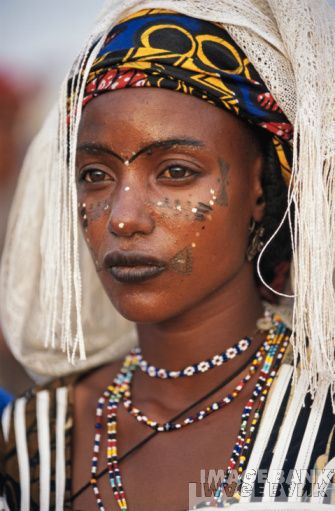
Being brave and fearless is also a very important aspect of the Fulani, and that is obvious by their numerous weapons. One tradition is that when two boys reach coming of age, the two boys hit each other with their spears, not showing any pain but instead laughing. Many have died in these ceremonies, which are now against the law in many countries, but continue to be practiced.


The Fulani normally raise large amounts of cattle and have therefore settled in the large plain areas of Mali, Niger, Burkina Faso and Guinea. The Fulani hold to a strict caste system. The four caste subdivisions are the nobility, merchants, blacksmiths, and descendants of slaves of wealthy Fulani.


Subscribe to:
Posts (Atom)